During my time as co-founder of Sew Studio CPH, we developed and facilitated a programme of public events, workshops and collaborative projects centred on circular textile practice.
Working with partners, volunteers and participants, we translated broad ideas about upcycling and resource responsibility into formats people could enter through their own hands. The programme moved between garment construction, material experimentation, repair, remaking and collective learning, primarily at Spor10, with additional collaborations at IKEA Dybbølsbro and Module.
This case study documents the events as collaborative work, shaped through different skills, relationships and forms of participation. My contribution was rooted in material selection, garment construction, technical preparation, workshop development and facilitation, turning circular ambitions into practical processes that could be understood, tested and used.
FREE UPCYCLING WORKSHOP
IKEA DYBBØLSBRO · EARTH DAY · 23 APRIL 2026
IKEA DYBBØLSBRO · EARTH DAY · 23 APRIL 2026
What happens when discarded bedding is treated as garment material rather than waste?
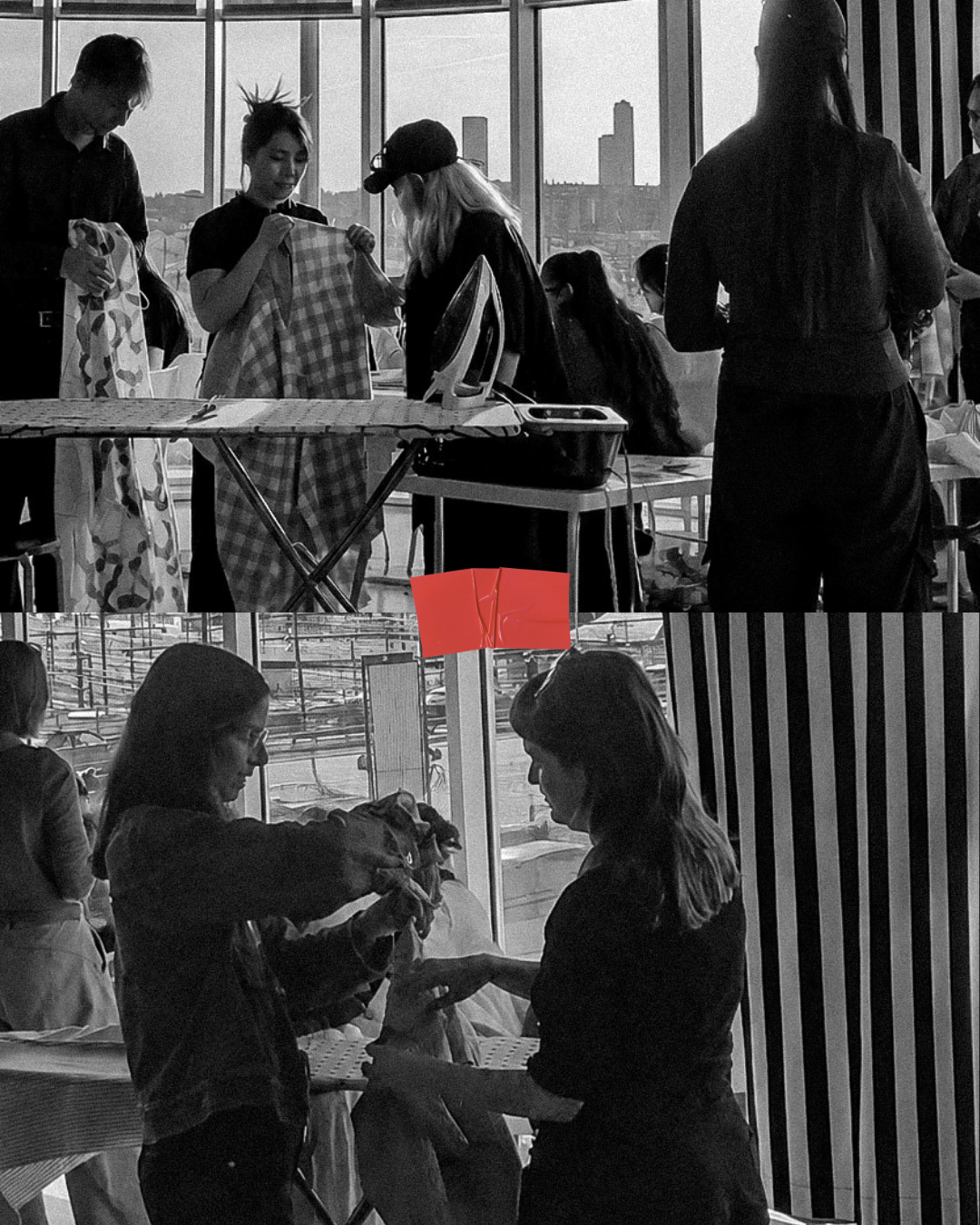
Presented as part of the Earth Day programme at IKEA Dybbølsbro, the workshop invited around 20 participants to transform discarded IKEA textiles- primarily sheets and duvet covers- into kimono-style pyjama tops and oversized shorts. The workshop was free, open to everyone and required no previous sewing experience.
The public event was supported by extensive technical preparation. As part of my role in developing the workshop, my contribution focused on production planning, garment construction and preparing the workflow for a limited timeframe. Based on experience from previous workshops, the process was structured so participants could concentrate on assembling, composing and sewing their garments.
Before the event, pattern pieces were cut, and their raw edges overlocked, creating construction-ready components rather than unfinished pieces of fabric. A clear assembly system, developed with support from one of the studio’s volunteers, guided participants through the order of construction. When the prepared components ran out or when someone wanted to work with a different textile, the format remained flexible enough for additional pieces to be cut during the workshop.
Although everyone worked from the same basic patterns, the results were not standardised. Participants selected which textile components to combine and decided how colours, prints and surfaces should meet within the garment. The format therefore created a form of structured co-creation: the technical framework was prepared in advance, while the final visual expression remained in the hands of each participant.
Rather than approaching Earth Day solely as a moment of awareness, the workshop translated its environmental message into direct material practice. Discarded textiles became the basis for technical learning, personal authorship and new garments, making circularity something participants could actively take part in.


RE: OPEN TEXTILE LABORATORY
SEW STUDIO CPH × MODULE
13 FEB · 6 MAR · 3 APR · 1 MAY 2026
VESTERGADE 2B, COPENHAGEN
SEW STUDIO CPH × MODULE
13 FEB · 6 MAR · 3 APR · 1 MAY 2026
VESTERGADE 2B, COPENHAGEN
Can circular textile practice enter a space without asking the space to become a traditional workshop?
The original RE concept was initiated by my co-founder and first tested through events at Spor10. Its relocation to Module and the development of a format adapted to the venue became a collaborative process. The connection to Module came through co-op member John Florio Barimani, whose introduction made the collaboration possible.
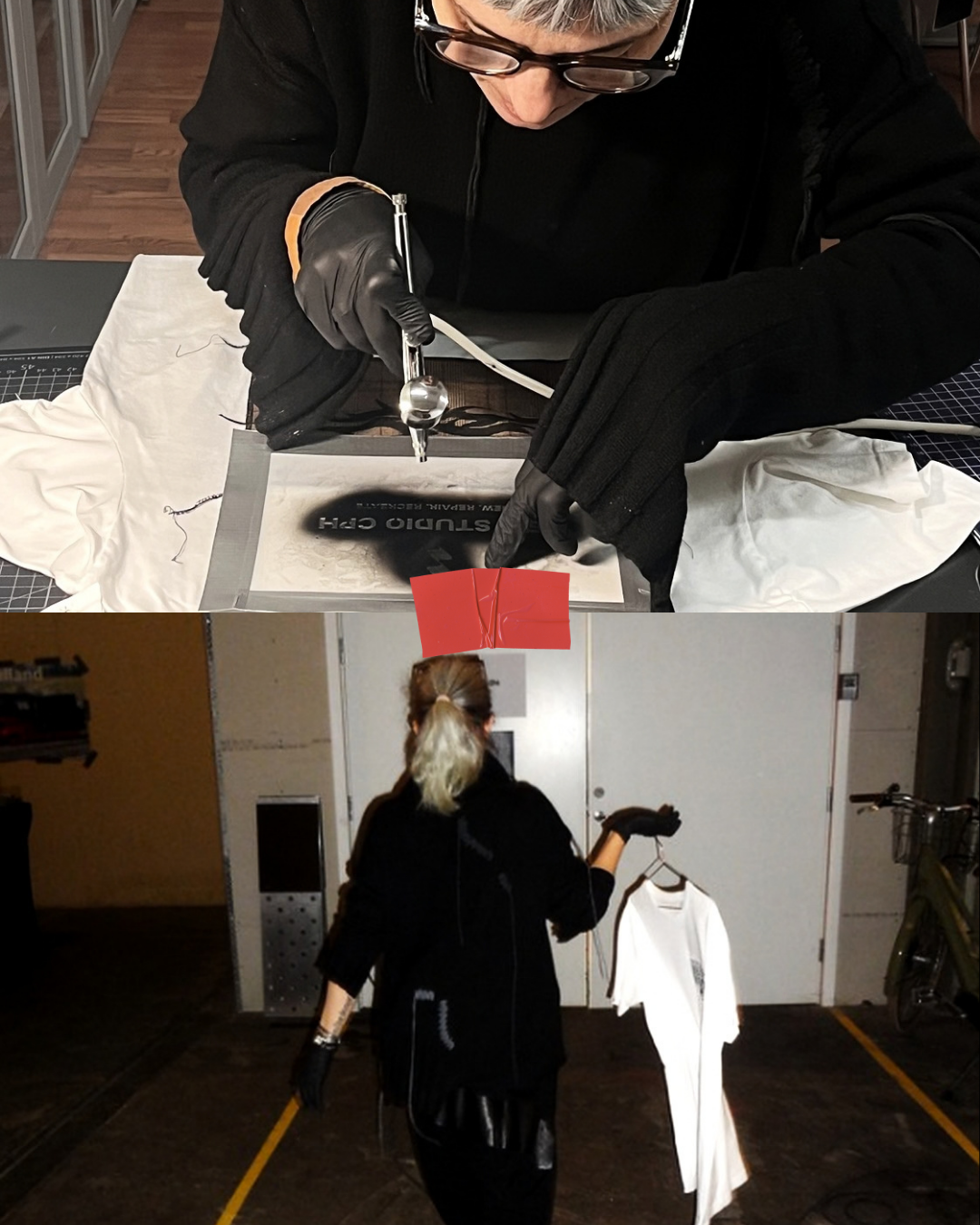
Held as an open drop-in event from 17:00 to 23:00, RE brought textile transformation into the social environment of a Copenhagen nightlife venue. Participants could arrive throughout the evening, listen to electronic music and work directly with garments through airbrush, roller printing, stencils, prepared motifs and cutouts.
Within the collaboration, my contribution focused on material methods, technical facilitation and teaching. Drawing on my previous work with airbrush and participatory textile workshops, I introduced accessible surface-design techniques that required no prior experience. I also helped translate these methods into an open drop-in format, ensuring that the process remained accessible and workable within the setting of a nightlife venue.
Participants could bring garments from their own wardrobes or work with cleaned, discarded T-shirts sourced from UFF Humana and Råstof by the Danish Red Cross. Some T-shirts had been prepared with an airbrushed Sew Studio CPH logo, which participants could use as a starting point and transform further through their own choices of motif, colour, placement and composition.
Bringing personal clothing into the process introduced an element of emotional durability: rather than replacing a garment that had lost its relevance, participants could alter its expression and create a reason to wear it again. The focus was visual transformation rather than repair.
The four editions were not organised around separate themes. Instead, the format developed iteratively, with each evening informing the next. While the first events were supported primarily by Sew Studio CPH’s existing network, Module’s own audience gradually began to engage with the workshop. This shift was central to the project: circular textile practice was introduced directly into an established community rather than waiting for that community to enter a conventional sewing space.
RE also sharpened my understanding of the difference between participation and co-creation. Participants were given meaningful visual choices, but they worked within a framework that had already been partly defined. The project demonstrated that accessibility depends on structure, while genuine co-creation depends on how much influence participants are given over the final outcome.


SUSTAINABLE FASHION TECH GRADUATE SHOW
SEW STUDIO CPH × SPOR10
30 JANUARY 2026
JERNBANEBYEN, COPENHAGEN
SEW STUDIO CPH × SPOR10
30 JANUARY 2026
JERNBANEBYEN, COPENHAGEN
What does it take to turn a missing format into a shared professional platform?
The Sustainable Fashion Tech Graduate Show was initiated by my co-founder and me in response to something we had both experienced ourselves: completing a professional bachelor’s degree without a public graduate show to mark the transition from education into professional practice.
We wanted to create the kind of conclusion we had missed: a professional setting in which the graduating Sustainable Fashion Tech cohort could present their bachelor collections, share their individual approaches and allow the work to meet an audience beyond the educational environment.
Each designer retained ownership of their collection, models, styling and individual presentation. Our role was to develop the framework around the work: bringing the participants, venue, partners, crew and technical production together as one coherent public event.
The show was developed within approximately one month. With several independent contributors involved, the process depended on creative alignment, clear expectation management and a practical division of responsibilities. A shared direction for the space and overall audience experience was developed collaboratively between Sew Studio CPH, KANT and representatives from the graduating cohort.
The production was developed through shared concept work, student and venue coordination, partnership building, and the organisation of crew and volunteers. Within this collaborative structure, my role was concentrated at the point where the collective ambition had to become operational.
This involved translating shared decisions into clear responsibilities and a workable run of show, with particular responsibility for runway choreography and backstage coordination. During the event, the focus was on maintaining an overview of models, transitions and the sequence of presentations, while supporting the different areas of the production as they came together in real time.
One of the central challenges was to create a visually coherent and professionally resolved fashion show within a limited financial and material framework. SPOR10 provided a large industrial space with a raw concrete floor, while discarded textiles supplied by Elis Denmark and IKEA Copenhagen were used throughout the scenography, backstage and lounge areas.
Rather than concealing these constraints, we worked with them as active elements of the show’s visual identity. The industrial architecture, lighting and discarded materials were brought together to create a setting that felt deliberate rather than provisional. The process demonstrated how resource limitations can become part of the design language when materials, space and technical production are considered as one interconnected system.
The show welcomed more than 300 guests and created a public platform for the graduating designers’ work. It brought students, collaborators, volunteers, partners and an audience together around new perspectives on sustainability, innovation and responsible fashion practice.
This was never just a show. It was proof that a self-organised creative community can build a professional platform and that responsible fashion can engage an audience when it is given space, visibility and a shared context.
For me, the production confirmed the value of working across creative direction and operational coordination: aligning expectations, organising people and resources, directing backstage and maintaining the overall flow from planning to live execution.
The production was made possible through a wider network of partners, sponsors and volunteers


DESIGN METHODS AS SOCIAL PRACTICE
SEW STUDIO CPH × ALENEMORSKAB
31 JAN · 7 FEB 2026
SPOR10, COPENHAGEN
SEW STUDIO CPH × ALENEMORSKAB
31 JAN · 7 FEB 2026
SPOR10, COPENHAGEN
How much structure does participation need?
Developed with Alenemorskab and SPOR10, this two-part workshop connected textile practice with Alenemorskab’s wider work of creating strength-based communities for mothers navigating motherhood on their own and their children.
The free workshops formed part of Alenemorskab’s Saturday programme at SPOR10 and typically brought together approximately 13–15 mothers and children at a time. The aim was to make textile transformation accessible across different ages and levels of experience.
A print method using broad stencil brushes, textile sponges and pre-cut illustrations was developed specifically for the participants. The tools were easy for small hands to control and offered a clear process without determining the final result.
Discarded T-shirts and children’s garments from UFF Humana were made available alongside clothing brought by the participants. Alenemorskab provided tote bags for the event, while a dedicated Alenemorskab stencil developed by my co-founder was included among a wider selection of motifs.
The workshops were developed collaboratively. My work was primarily situated in the practical and participant-facing process: adapting the method, preparing materials and guiding participants through printing and colour mixing.
Within the prepared framework, participants selected their own textiles, motifs, colours and placements. Once the method had been introduced, the children settled into the process with greater focus. Conversations emerged around colour, composition and technique, while children and adults worked alongside one another.
The finished pieces were completed and taken home the same day. Existing textiles received renewed expressions, while the process created space for shared attention, learning and conversation.
The workshops demonstrated that accessibility does not come from removing structure, but from designing the right amount of it. Here, design became a way of organising participation, leaving meaningful room for individual expression within a shared experience.


OPEN STUDIO - THREE WAYS IN
OPEN WEDNESDAYS · OPEN STUDIO SATURDAYS · RE
SEPTEMBER 2025 JUNE 2026
SPOR10, COPENHAGEN
OPEN WEDNESDAYS · OPEN STUDIO SATURDAYS · RE
SEPTEMBER 2025 JUNE 2026
SPOR10, COPENHAGEN
How can an open textile workshop accommodate curiosity, technical learning and social participation within the same space?
During my time as Co-Founder of Sew Studio CPH, we developed three recurring formats at Spor10, each offering a different way into textile practice.
Open Wednesdays provided a low-threshold introduction to the studio as part of Spor10’s weekly programme and community dinner. Visitors could explore the workshop, receive an introduction to domestic and industrial sewing machines, overlockers, textile printing and heat-press equipment, and complete simple exercises designed to build confidence before beginning an independent project.
Open Studio Saturdays created space for more focused project work. Participants arrived with garments, patterns and ideas that often required technical support to move forward. The format offered guidance in garment construction, pattern interpretation and adaptation, fitting, repair, remake and upcycling, helping participants develop or complete projects that had previously stalled.
RE transformed the workshop into a monthly social evening centred on textile experimentation, music and informal exchange. Guests could bring garments from their own wardrobes or purchase discarded textiles sourced from UFF Humana, then explore accessible surface-design and print techniques in a more relaxed setting.
Within the shared organisation of the formats, my work centred on participant-facing teaching and technical guidance. My background as a trained tailor and garment technologist enabled me to support both first-time users and participants working with more complex construction challenges. The formats were supported by a professional equipment base, including machinery made available through my prototype practice as a co-op member.
Together, the three formats demonstrated that access to a workshop is about more than opening its doors. Meaningful participation also requires equipment, guidance and different levels of entry, from an initial encounter with a machine to the completion of an independent garment. Over time, the formats generated visibility, returning participants, new members and a community built around learning through textile practice.


UFF HUMANA - FROM MATERIAL FLOW TO PRACTICE
TEXTILE ACTIVISM GROUP → SEW STUDIO CPH
SPOR10, COPENHAGEN
TEXTILE ACTIVISM GROUP → SEW STUDIO CPH
SPOR10, COPENHAGEN
What does it take to turn a supply of discarded clothing into a material resource that can support learning, design and local circulation?
The collaboration with UFF Humana originated through my work as Project Lead at Textile Activism Group, where I co-developed TAG CO-LAB: a platform model connecting circular material flows, independent design practices, shared production facilities and public participation.
I later brought the partnership into Sew Studio CPH, where discarded textiles from UFF Humana became part of the studio’s material foundation. More than one tonne of clothing was received at Spor10 and processed through a systematic intake and sorting practice.
The work extended beyond handling a donation. Each garment had to be opened, assessed and understood according to its condition, construction, material properties and potential next use. This transformed sorting into an active design method, one capable of distinguishing between direct reuse, repair, remaking, workshop application and further material processing.
Within Sew Studio CPH, the textiles were made available through open-studio activities, workshops and participant-led projects. The partnership demonstrated how an established material relationship could be carried into a new organisational setting and translated into practical access: not simply moving discarded clothing from one location to another, but creating the knowledge, infrastructure and facilitation required to put it back into circulation.


WHEN DISCARDED TEXTILES BECOME NEW VALUE
SEW STUDIO CPH × IKEA DYBBØLSBRO
FOUR-PART WORKSHOP SERIES · WEEKS 4–7, 2026
COPENHAGEN
SEW STUDIO CPH × IKEA DYBBØLSBRO
FOUR-PART WORKSHOP SERIES · WEEKS 4–7, 2026
COPENHAGEN
How can discarded household textiles become an accessible starting point for learning, making and circular participation?
The workshop series formed part of a longer professional dialogue with IKEA. I first established contact with the organisation during my work with Textile Activism Group, following an introduction facilitated by Spor10. The later programme at IKEA Dybbølsbro was developed and delivered collaboratively during my time as Co-Founder of Sew Studio CPH.
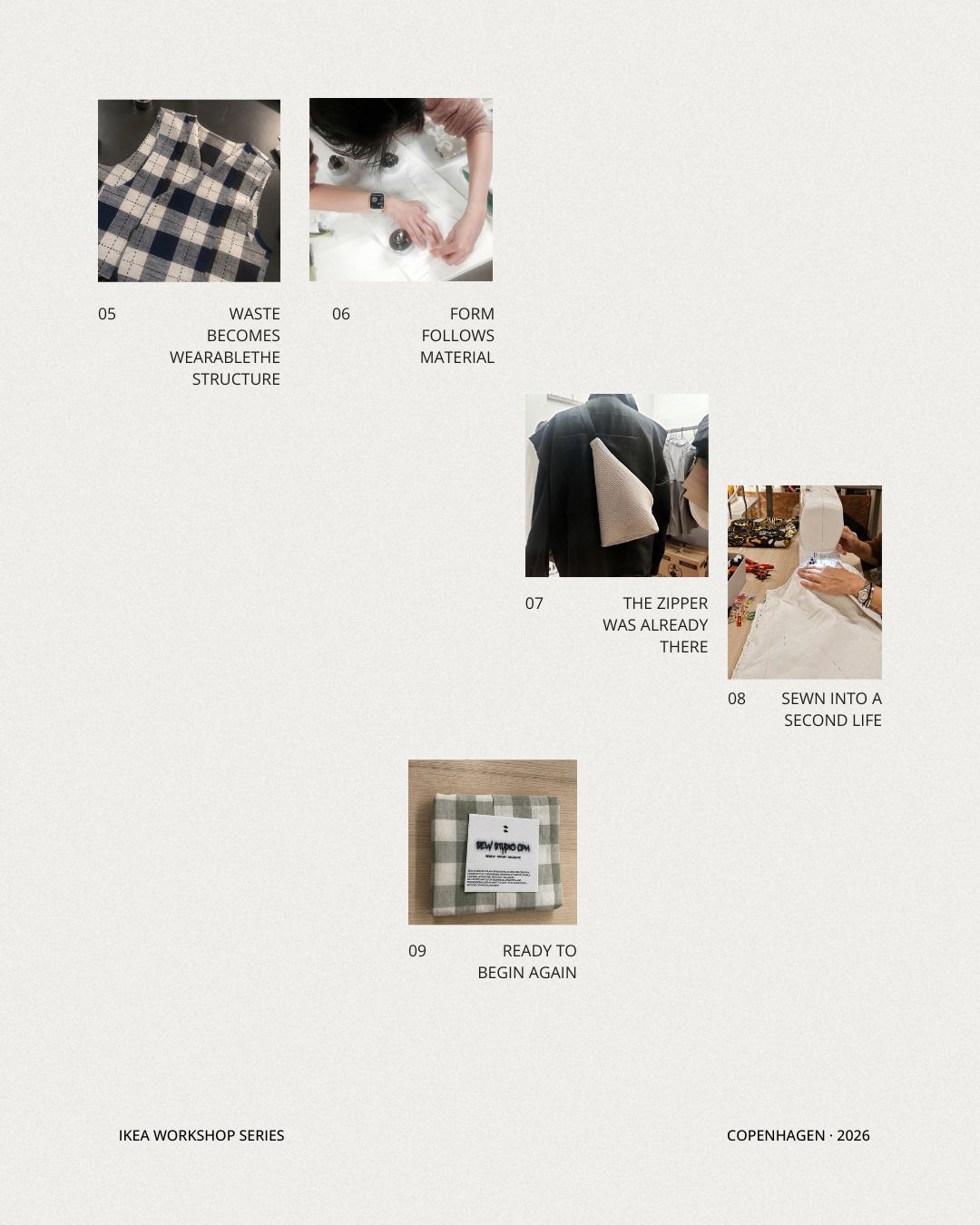
Across four free workshops, participants worked hands-on with textiles discarded by IKEA. Rather than approaching the materials as an anonymous waste stream, the format began with their existing properties: scale, structure, surface and embedded components.
Two projects introduced different circular strategies. Discarded cushion covers became bags, allowing the existing zips to remain in use rather than adding new trims. Discarded bedspreads were remade into vests, using their larger textile surfaces as the foundation for a new garment.
Within the collaborative development of the programme, my work centred on material interpretation, construction methods and participant guidance. The projects were structured to make the processes approachable without removing the participants’ ability to influence material combinations, details and final expression.
The series demonstrated that accessible circular design begins with more than a message about waste. Participants need to encounter the material directly, understand what is already present and experience how technical decisions can extend its usefulness.
The result was not only a collection of finished objects, but a practical shift in perspective: from discarded textile to design material, from passive consumption to active participation, and from an exhausted function to a new possibility.


A PRINT OF THEIR OWN
SEW STUDIO CPH × MILLS CLUB · FERIE CAMP
27–30 DECEMBER 2025
SPOR10, COPENHAGEN
SEW STUDIO CPH × MILLS CLUB · FERIE CAMP
27–30 DECEMBER 2025
SPOR10, COPENHAGEN
How can a T-shirt become more than an activity and instead express belonging to a shared community?
Developed in direct collaboration with Bonnie, Chair of Mills Club, this four-day workshop introduced textile printing as part of Ferie Camp at Spor10. The workshop was free for Mills Club’s younger members and operated as an open drop-in activity alongside the camp’s programme of skating, sport and movement.
Participants worked with a combination of new T-shirts, discarded garments sourced from UFF Humana and former Mills Club T-shirts made available for renewed use. Every child was able to complete a personally designed T-shirt and take it home the same day.
The printing method was adapted to accommodate different ages, levels of experience and lengths of participation. Using prepared stencils and textile tools that could be handled without prior technical knowledge, the children made their own decisions about motifs, colours, placement and composition. Colour mixing became part of the guidance, connecting visual choice with a practical understanding of the process.
Mills Club’s existing graphic material could also be applied using a heat press. This introduced a second technique while allowing the children to combine the club’s shared visual identity with their own individual expression.
The format remained flexible: children arrived directly from the skate activities, participated at their own pace and often stayed beyond the scheduled workshop hours. Rather than requiring the energy of the surrounding environment to disappear, the workshop created a creative activity that could function within it.
What emerged was more than a decorated garment. The T-shirts became personal records of both individual choice and collective belonging, connecting each child’s expression to a club, an activity and a community they already identified with.
The practical delivery was supported by co-op member John Florio Barimani, together with volunteers from Mills Club.


WORKING WITH WHAT REMAINS
SEW STUDIO CPH × SPOR10 ONSDAG
3 · 10 · 17 DECEMBER 2025
SPOR10, COPENHAGEN
SEW STUDIO CPH × SPOR10 ONSDAG
3 · 10 · 17 DECEMBER 2025
SPOR10, COPENHAGEN
What forms of value can be created from the fragments left behind after remaking?
This three-part workshop series was developed within my role at Sew Studio CPH in close collaboration with volunteer Sara. Held during Spor10 Onsdag, the free workshops invited children, young people and families to participate in two hours of collective making before the weekly community dinner.
The material base consisted of offcuts and irregular fragments generated while working with post-consumer textiles sourced through UFF Humana. Too small for most garment construction, these residual materials became the starting point for textile garlands, small Christmas trees, ornaments and individually interpreted gifts.
The activities were designed around accessible hand-sewing techniques. Participants sorted, folded, layered and stitched the fragments without using sewing machines, allowing younger children to work alongside adults while older participants could develop their ideas more independently.
Rather than prescribing one identical outcome, the workshops offered a shared method that could be interpreted through personal choices of material, colour, composition and form. Each object was completed during the session and taken home the same day.
Positioning the workshops directly before the community dinner embedded circular textile practice within an existing local gathering. Participants did not need to enter a specialist design environment; making became part of the social rhythm already present at Spor10. Several returned across the three Wednesdays, creating continuity between the individual sessions.
The series demonstrated that even the smallest textile remnants can retain creative and social potential. Through an intimate, intergenerational format, materials with limited practical value became a reason to gather, exchange knowledge and make something meaningful together.


