From Waste to Worth · A Material-Led Design Exploration
An existing garment brings its own conditions to the design process: a worn surface, a fixed seam, a pocket already shaped by use. In From Waste to Worth, these details became starting points for exploring how discarded clothing could take on another form while retaining traces of its previous life.
Developed in collaboration with Textile Activism Group (TAG), this project brought together remaking, material exploration and digital prototyping. The work presented here focuses on my contribution as a designer and garment technologist: examining existing materials, exploring construction possibilities and developing connections between physical garment components and digital tools.
My tactile portfolio book gathers the material thinking behind this process. Fabric samples, garment fragments, sketches and handwritten notes sit alongside one another, allowing ideas about silhouette and function to be considered against the texture, wear and dimensions of the available textiles. The pages hold questions as well as decisions: what can be preserved, what needs to change, and how might an existing detail suggest a new direction?
The following spreads trace this exploration through the materials and construction choices that shaped it, moving between hands-on investigation and experiments with Logic Trace System for Apparel and CLO3D.

Exploring Form Through Layers
Hand-drawn vests and trousers take shape through transparent sketches layered over dark body silhouettes. I move the drawings, exchange proportions and explore how the pieces might be worn together.
Denim samples showing wash and colouring variations sit alongside leather fragments, bringing texture and contrast into these first design ideas. Within my handmade portfolio, the layers remain movable, a way of thinking through touch, where a shift in material or silhouette can suggest another direction.
Pockets in Motion
Here, I explore pockets as detachable elements that can move between different positions on the garment. On the cargo trousers, influenced by Japanese workwear, the pockets could be removed and buttoned together to form a bag, allowing their function to travel beyond the clothing.
Existing denim pockets provided a starting point, while their shape and grain direction raised construction questions. These studies bring versatility into the design: how might a detail change both the silhouette and the way a garment is used?


Memory Cloth
Time weaves through cloth, through layers of memory that belong to no one and everyone. Clothing discarded, abandoned, is an echo of lives we never knew. It carries traces of other people’s dreams, their losses and triumphs, like a hidden text woven into its seams.
Who wore this jacket before it was put away? Who loved in this shirt, danced in these trousers, cried into this scarf? We do not know. But we sense it like an invisible energy vibrating through the fabric.
When we gather the remnants, we awaken memories laid to rest. We build upon their stories, extend their lives. Give them new settings, new meanings, new owners. An old piece of cloth is reborn, as though it could hold on to time even when we cannot.
Memory Cloth is more than reuse. It bears witness. A tribute to what we let go of and what we create. Each imprint is a gesture towards the past and the future, where memories meet in a moment of aesthetic balance.
Aesthetic Wear & Tear
We used “Aesthetic Wear & Tear” to describe the beauty we found in traces of previous use. Existing wear and patina became part of the garment’s visual language, explored alongside washing and over-dyeing.
Here, I develop the selected designs through proportion, construction and function, drawing on Japanese workwear. A detachable pocket becomes a bag, extending its use beyond the garment. The exploration brings practical versatility into conversation with surfaces that carry a history.


Details That Shape the Next Life
I compare reclaimed lamb and cow leather through thickness, softness and the traces left by time, exploring leather conditioners to refresh their surfaces.
The existing fastenings, eyelets and seams alongside these samples raise another question: what do our design decisions leave behind? A detail may offer character or function, yet its holes and placement can limit future remaking. Here, I consider how much a garment needs and how each addition might shape the material’s next life.
Designed to Come Apart
Through fastening samples for the jacket, I explored how a button could serve its purpose and later be removed. I selected screw-on metal buttons, allowing the fastenings to be unscrewed for reuse and the metal separated for potential recycling.
The choice considers what happens beyond the garment’s first life. Each button needs a reason to be there: its function, placement and the hole it leaves all become part of designing for future remaking.


Colour as a Connecting Layer
In collaboration with Textile Activism Group (TAG), I explored enzyme washing with BioRestore followed by over-dyeing with Octarine Bio. In our samples, the washed denim took on a more even colour than the untreated denim.
For me, this offered a way to bring differently worn surfaces into a shared visual language. The colour formed a new layer over the existing patina, lending coherence to the materials while allowing traces of their previous lives to remain part of the design.

From Fragments to Digital Possibilities: I traced deconstructed denim pieces using Logic Trace and transferred their outlines into CLO3D as DXF files. Working with a pocket on my small digitising board, I explored how an existing fragment could become a starting point for design. Its irregular shape became something to work with: a material boundary from which new possibilities could emerge.

An Existing Pocket, a New Function: In CLO3D, I explored how a deconstructed pocket could take on a new function, testing its volume, construction and placement on the body. This small-scale experiment began with the material already available. It opened a direction for further exploration: digitising larger reclaimed pieces and developing new forms within their existing boundaries.

Giving Fragments Form: I developed the patterns in CLO3D, then cut and sewed the reclaimed denim into panels, aligning the grainlines to support the garment’s balance and fit. Here, the different shades and traces of wear remain visible. These images show my construction process before I overdyed the assembled garments to bring the contrasting surfaces into a shared colour expression.

Preparing a Shared Colour Expression: These sample trials explored enzyme washing with BioRestore followed by over-dyeing, aiming to connect reclaimed denim with different washes and wear histories through a more coherent colour expression. Octarine Bio was considered as a potential collaborator; the trials shown used a different dye system. In the project samples, the washed denim showed more even colour uptake than the untreated material. This observation informed the finishing approach, with colour forming a connecting layer over the existing patina.
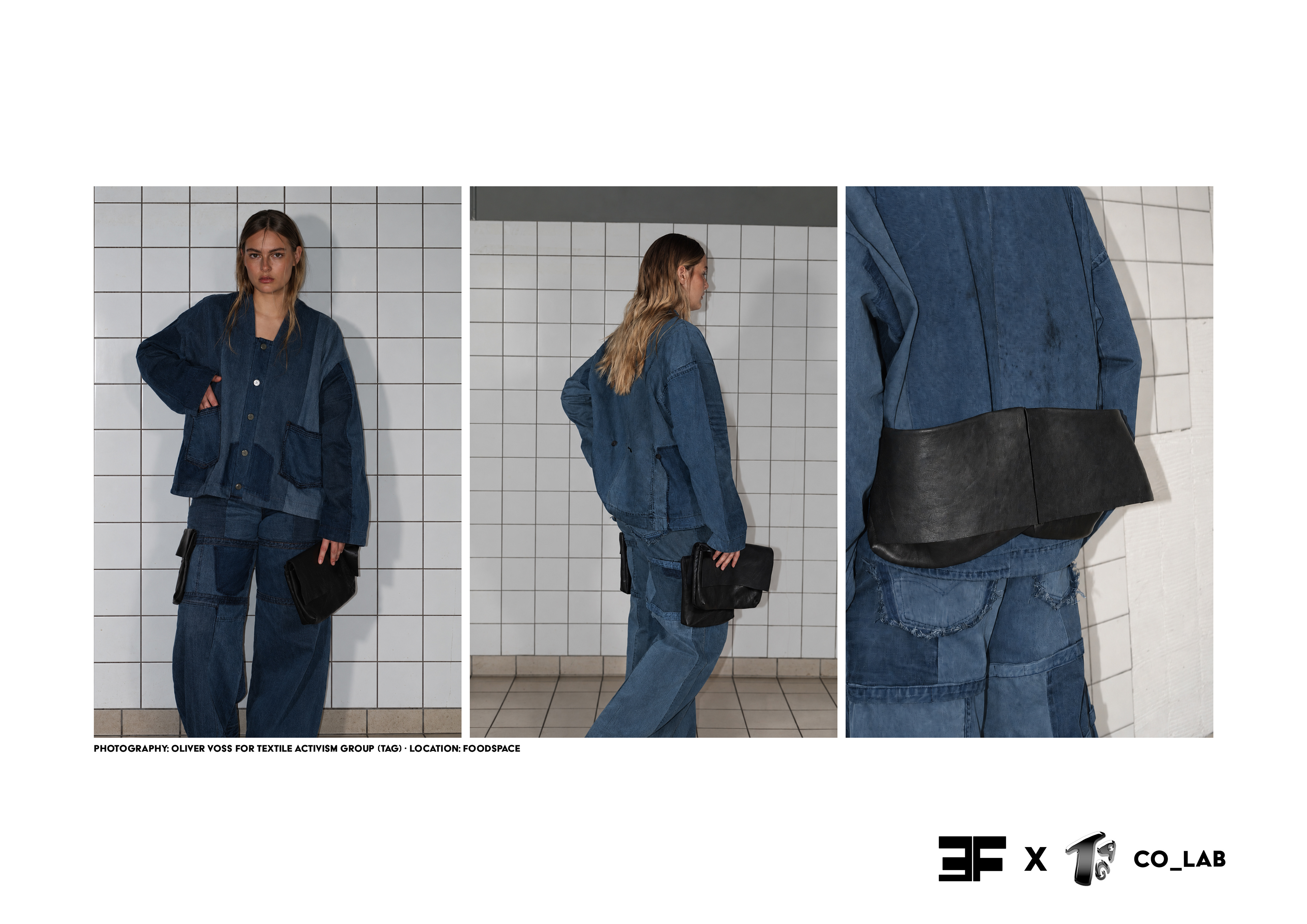
From Construction to the Body: The denim prototype brings the collection’s material and construction decisions onto the body. The generous jacket and panelled trousers combine reclaimed denim with detachable leather elements. Front, side and detail views reveal how volume, seam placement and existing garment fragments work together. The prototype provides a physical basis for assessing silhouette, balance and the relationship between the clothing and its adaptable accessories.
Imagining the Collection’s World
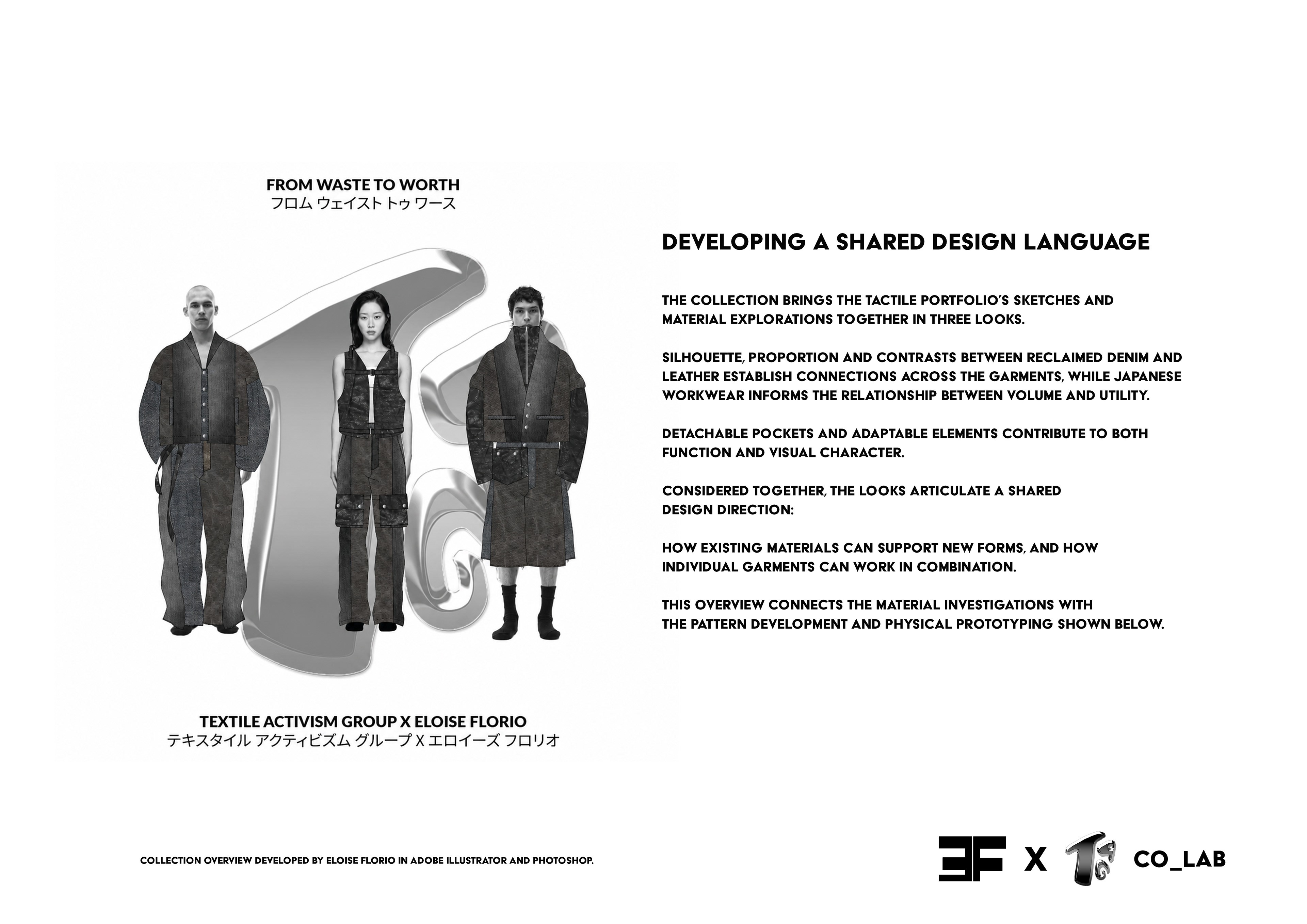
The following AI-generated images explore the visual world envisioned for From Waste to Worth. Developed by Eloise Florio, they translate the collection’s design language into an editorial setting, exploring how silhouette, styling, light and space shape the way clothing is perceived.
The aesthetic intention lies in the tension between utility and sensibility: generous volumes, worn surfaces and functional details carrying a quieter sense of refinement. Material history becomes part of the atmosphere, allowing reclaimed textiles to be imagined within a contemporary fashion narrative.
These visualisations express an artistic direction. The physical prototypes and their construction process are documented above.


From Waste to Worth begins with what the material already holds: a seam, a faded area, a shape inherited from another garment. Across tactile exploration, digital development and physical making, these traces become conditions for new design.
The imagined world extends that enquiry into how the garments might be seen and desired. A question remains open: how can clothing carry its past into a new expression and invite someone to become attached to it again?


